Showing posts with label books. Show all posts

Tuesday, July 3, 2012

The Fault in Our Stars by John Green

“Headline?" he asked.
"'Swing Set Needs Home,'" I said.
"'Desperately Lonely Swing Set Needs Loving Home,'" he said.
"'Lonely, Vaguely Pedophilic Swing Set Seeks the Butts of Children,'" I said.


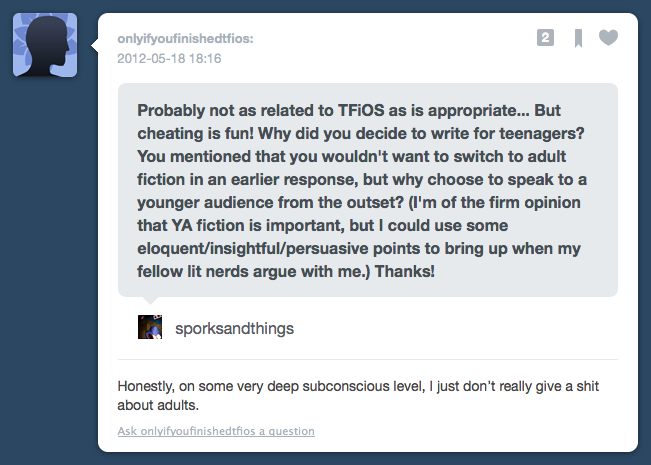
Having lent out both of the novels I own by him last week to people*, I figure that now is a great time to talk about John Green's books. Because why be practical about this 'reviewing' process when I could follow my impulses and be vague and obnoxious instead? Particularly since, you know. He and I are now bestest buddies in the whole wide world.

* I did that a month ago. Yes. This has taken a month to write. Writing blog stuff is hard, okay? And no. They haven't given the books back. Impatience goes here.

Note before I get too deeply into this that I'm going to be exerting a lot of effort in staying somewhat focused on the book, since I find many things about John Green fascinating. Keeping in mind that I usually am content to analyze authors from afar while enjoying their work rather than engage with them in any real sense, I find it both awesome and a bit problematic that Green is so damn accessible to his readers/fans, and I can't help but wonder how that changes the reading process. I want to draw the easy comparison (which, therefore, probably wouldn't be accurate at all) to a Letters/Rilke scenario, but on a much larger scale and through much more immediate mediums. (And also regarding non-authory things.) There's also my personal hobby horse of proclaiming popular YA fiction as important social indicators for a culture and a good way to track the trajectory of societal norms, which is something I always want to rant about... (Even if John Green is less inclined to. I forgive him though. Because we're BFFs and all.)

But, instead. Books. Let's talk about his books. Because I've read two of them and I like them a great deal. For the sake of making things slightly easier for myself, I'm going to stick with The Fault in Our Stars, since I finished that one most recently and I like it more. (Sophisticated analysis, to be found right here ladies and gents.)

That excessive preface out of the way...

I started reading The Fault in Our Stars knowing that it was about a sixteen-year-old girl, Hazel Grace Lancaster, with terminal cancer who falls in love.

Wednesday, February 1, 2012

The Memory Artists by Jeffrey Moore

I initially read The Memory Artists when I was fifteen, and it was the first time that I realized that contemporary fiction had something different and interesting to offer that the brilliant old books couldn't.

Which - and I must emphasize this before I get pelted with stones - doesn't mean that they're better. Or even a fraction as good. Or worth the paper they're written on. Or whatever.

What it does mean is that by virtue of being newer, they can act as reactionary commentaries of the times in which they're published. A current commentary of the universe as it stands at a particular moment. (Which is also a reason why I like television so much, should anyone care.) There are also printing methods available now that Homer couldn't really get his hands on. Books can include pictures, colors, different font types and news article clippings. The comprehensive view of the world has changed from now from back in the good old days, and we can be more connected to people half way around the world than we are with those next door. It's not to say that these 'bells and whistles' can't become crutches that novels lean on, but when these little tricks work? The results can be pretty cool.

Thursday, August 11, 2011

The Dice Man by Luke Rhinehart

Traditional autobiographies wish to help you understand how the adult was "formed." I suppose most human beings, like clay chamber pots, are "formed" - and are used accordingly. But I? I am born anew at each green fall of the die, and by die-ing, I eliminate my since. The past - paste, pus, piss - is all only illusory events created by a stone mask to justify an illusory stagnant present. Living flows, and the only possible justification of an autobiography is that it happened by chance to be written - like this one. Someday a higher creature will write the almost perfect and honest autobiography: "I live."

Sophomore year in college I bought a really idiotic book called something along the lines of, America's Best Cult Fiction. What can I say? I wanted (okay, fine - want) to be a cool kid, and that meant (means) reading more obscure - but good - books than anyone else. So I read a book to tell me what books to read to be cool. (See that awesome logic there?) Ultimately, being the poor person I was (am), I could only afford to buy one real book after the purchase. So, after carefully studying my options, I bought The Dice Man by Luke Rhinehart (which is a pen name - henceforth when I'm speaking about the author, I'll refer to him by his real name, George Cockcroft (yes, that is a ridiculous surname) to avoid confusion). I then ignored it for three years. I do that a lot, I know.

Two months ago I hauled it back with me to New York from California, and I finally got around to starting it last week. And couldn't stop. Which, for the first time in my history as a reader, actually worried me a bit. There was something freakishly seductive about the book and the lifestyle it was fictionalizing, something oddly compelling about abandoning the construction of self for a life lived purely based on the whims of chance.

The premises of the book is thus: What if you left every decision up to the roll of a die?

Monday, May 9, 2011

Seven Types of Ambiguity by Elliot Perlman

"The peculiar striations that define someone's personality are too numerous to know, no matter how close the observer. A person we think we know can suddenly become someone else when previously hidden strands of his character are called to the fore by circumstance." 

The problem with a book that has ‘ambiguity’ in its name (or worse, that claims ambiguity as a theme) is that it can get away with anything. “But you’re not supposed to get it. It’s ambiguous. Like in the title. Pay attention, dumb ass.” This makes Elliot Perlman’s Seven Types of Ambiguity problematic, because as interesting and creative as it can be, it can also lose itself in its own gimmick. 

 The plot of the book is simple. One day, a man (Simon) picks up an ex girlfriend (Anna)’s son (Sam) from school without her permission, gives him a glass of chocolate milk, and gets arrested. From that starting point Perlman creates a six-hundred page unconventional mystery. Not that we’re ever wondering ‘who done it’ as the story progresses. Instead, we have to speculate on  how characters react, how situations unfold, and what motivates the people moving the story forward. This is complicated by the division of the book into seven sections, each with a unique narrator who illuminates the developing story of the novel in unexpected ways. We often backtrack through the story, frequently take unexpected turns, and sometimes enter an entirely new structure of text, all the while making our way through the series of consequences that come about for a multitude of people when a man makes a stupid decision out of desperation. 

Wednesday, April 6, 2011

Mothering for Those Terrified of Children - Excitment and Concerns for Game of Thrones

Sean Bean as Eddard Stark = perfect casting
Let me preface this by saying that A Game of Thrones was the first book I read for fun that made my brain hurt. Keep in mind that I was twelve and just getting into reading, and that while I got all the sex, murder and intrigue on some level, I was coming off of Tamora Piece’s excellent (but oh-so-fluffy) teenage heroine fantasy quartets. They... aren't the same.

So I didn’t really get how good these books were until I was older and re-read them. At that point, I began to understand exactly what the novels were about. Not huge cool wolves and dragons, but an intriguing and wide-sweeping political drama told through a multitude of narratives and in a ‘fantastic’ setting. It was still cool, but it was also a lot more meaningful than it had been back in the days of, ‘Yay! Magic stuff!’ (I repeat – I was a bad-ass back in the day.)

Point is, I have a soft spot for these melodramatic, emotionally pulling books of epic proportions, so you can imagine my delight (and slight terror) when HBO announced that they were bringing them to the small-screen on April 17th. Delight because one of the most epic series of books to be made during our time is going to be put in just the visual medium it was meant for (movies are great, but for something like A Song of Ice and Fire? TV is so much better), with competent people in charge and a kick-ass cast.

Terror because if they mess it up I will be traumatized for life.

Wednesday, March 30, 2011

Self-Made Man by Norah Vincent

I curtailed everything: my laugh, my word choice, my gestures, my expressions. Spontaneity went out the window, replaced by terseness, dissimulation and control. I hardened and denied to the point almost of ossification.

About a two and a half years ago I started becoming interested in feminism when a guy in one of my classes couldn't read feminist literature without discomfort. He felt attacked, couldn't take it seriously, and thought that it had no relevance. He couldn't get past his prejudices long enough to see what these books were commenting on.


After that encounter, I started gearing my literary studies toward feminism and women writers, and the further I read into the field (strictly literature, mind you. I leave the theory to the intense folk) the more I realized that, as much as I disagreed with him, my classmate had a point. Not that I think he was being attacked by the feminist movement, or that he shouldn't have taken feminism seriously (or more importantly - been a feminist), but that the role of men in relation to feminism can often be incredibly problematic.

So a year later I got Self-Made Man: One Woman's Journey Into Manhood and Back Again by Norah Vincent on a whim. A year and a half after that (also known as last week) I actually read it, with fascinating results. The book itself is pretty much what it says on the tin. For a year and a half the lesbian, feminist, and philosopher extraordinaire Norah Vincent lives her public life as a straight man and decides that it's a lot less fun than she had thought it would be.

Tuesday, February 22, 2011

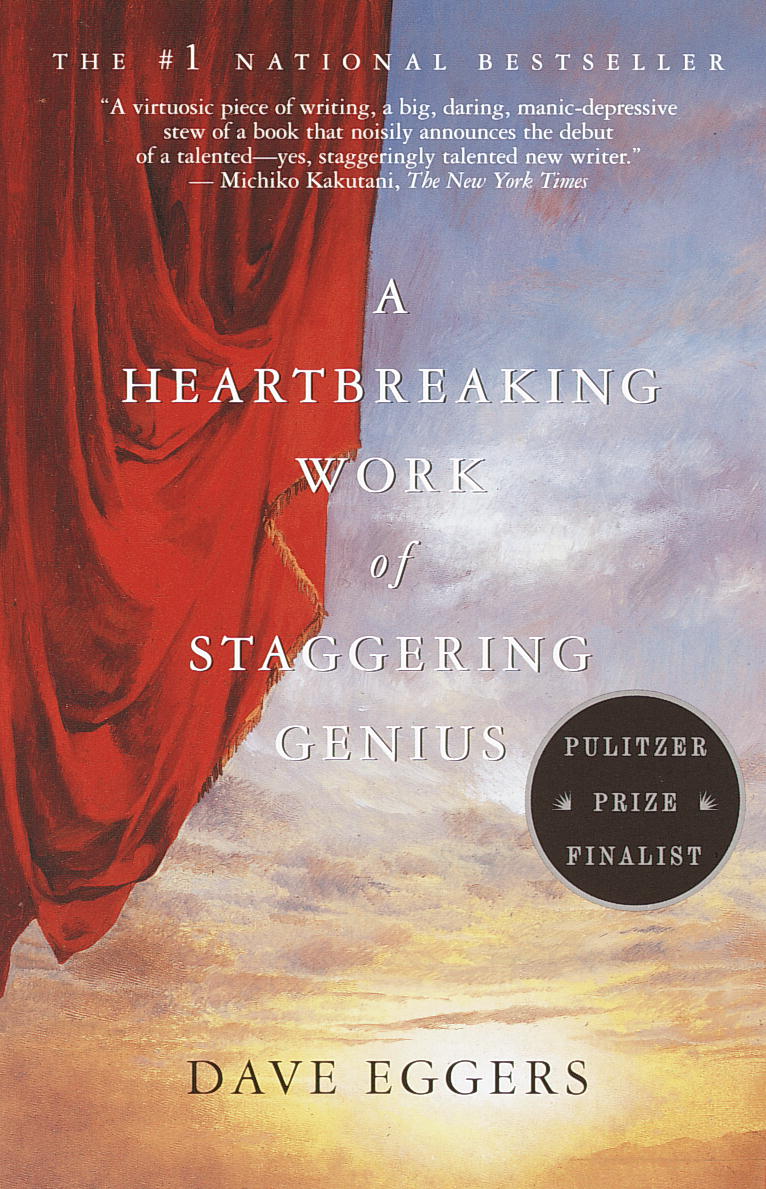
A Heartbreaking Work of Staggering Genius by Dave Eggers

"We have advantages. We have a cushion to fall back on. This is abundance. A luxury of place and time. Something rare and wonderful. It's almost historically unprecedented. We must do extraordinary things. We have to. It would be absurd not to." 

I feel like people have a lot of opinions about Dave Eggers for being, well. Dave Eggers. Personally, I have no idea what all the fuss is about. He supports good authors, he wrote a movie with his wife that I like (although the world seems to disagree with me on “Away We Go”…), and his name is being bandied about as one of the most influential contemporary authors of our day.

Since I sort of study contemporary authors (emphasis on ‘sort of’), it has looked pretty bad that I haven’t read him at all until a month ago. Happily, I borrowed his first book, A Heartbreaking Work of Staggering Genius, from a coworker, and now the masses can stop mocking me behind my back.

A Heartbreaking Work of Staggering Genius is a memoir, kind of. It’s Eggers’ real story as told by him, and is mostly based on fact and experience. The story itself is (as the title indicates) a heartbreaking one. When Eggers is twenty-one, his parents die within a few months of each other. He and his siblings are left trying to reconstruct their lives in the wake of this loss, and Dave is given the burden of taking care of their youngest brother, Toph. By itself, this story is an interesting, sad one that shouldn’t be dismissed as fictional trite nonsense. Because, well. It’s real life.

Monday, February 21, 2011

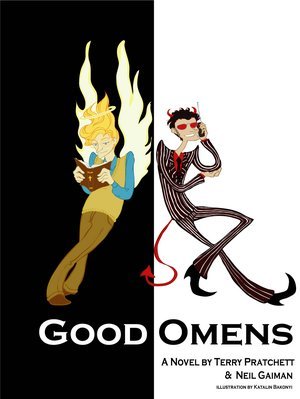
Good Omens by Terry Pratchett and Neil Gaiman


“Most of the members of the convent were old-fashioned Satanists, like their parents and grandparents before them. They'd been brought up to it and weren't, when you got right down to it, particularly evil. Human beings mostly aren't. They just get carried away by new ideas, like dressing up in jackboots and shooting people, or dressing up in white sheets and lynching people, or dressing up in tie-dye jeans and playing guitars at people. Offer people a new creed with a costume and their hearts and minds will follow.”

People have been telling me to read Good Omens by Neil Gaiman and Terry Pratchett for about eight years now. And I, in response to their well-meaning advice, have been nodding pleasantly, smiling, and then continuing on about my business reading my epic Dragon Lance novels. (Because I have always been one of the cool kids.) 

Back when I was a young and tender thing without the wisdom and insight I have today, I used to hate reading. Well. That’s not true. I just wasn’t any good at it. I’m certainly not dyslexic, but anyone who has heard me attempt to read aloud knows that the mechanics of my reading abilities are somewhat compromised. It makes spelling fun!

Tuesday, November 2, 2010

Thoughts on a Cosmological Scale - No One Belongs Here More Than You by Miranda July

Today on the train I finished No One Belongs Here More Than You by Miranda July.

Maybe I'm not deep enough, but I really didn't enjoy the collection until the last story, which is probably because I don't typically like shorter pieces of prose. There's something about growing with a book that I appreciate, and that I can't seem to get out of short fiction. It's not that collections can't impact me, because they can. And it certainly isn't because they're not any good, because they are. It's just that when reading shorter stuff, I never feel as if there's enough time for the stories to really capture me.